


Sunscreen: 11 Questions We All Ask
What does SPF mean?
SPF is the abbreviation for Sun Protection Factor, the index that measures how much sunscreen protects your Skin from UVB rays.
The SPF number indicates how much UVB radiation is filtered out by the product. SPF 15 filters approximately the 93% of UVB rays, SPF 30 the 97%, SPF 50 the 98%. What’s the practical difference between SPF 30 and SPF 50 sunscreen? Percentage-wise it seems negligible, but SPF 30 lets around 3% of UVB rays pass through, while SPF 50 lets just 2% through. Over prolonged sun exposure, that single percentage point translates to significantly higher protection.
SPF 10 and 20 are no longer recommended as basic sun protection: they filter far too little UVB radiation, especially given that in real life, people typically apply less sunscreen than the required amount. Today's standard baseline minimum recommendation is SPF 30.
What about SPF 100? In Europe, the maximum value that can be stated on a label is "50+": the UV protection it provides is over 98%, but the exact number is not printed, as performance differences above that level are too minor to matter. No sunscreen blocks 100% of UV rays in any case. If you see a sunscreen with SPF 100, it is most likely an American product, since that labeling is permitted in the US.
UVA and UVB rays: what is the difference?

UVB and UVA are two types of solar radiation that behave differently and cause different types of damage.
I rAdd UVB they have a shorter wavelength and stop at the surface layers of your Skin. They are the main cause of sun redness and burns: the acute damage that appears after an afternoon spent at the beach. When you see an SPF value on a product label, that protection level refers directly to shielding against these rays.
the UVA rays they have a longer wavelength and arrive more in depth, right down to the dermis. This is the radiation linked to photoaging: it causes wrinkles, dark spots, and loss of skin elasticity. Unlike UVB rays, these rays pass through glass and clouds. That’s why using sun protection makes sense even in winter, even when you’re in a car, even behind an office window.
On product labels, SPF alone is not enough to confirm that a product protects against both types of radiation. To be sure that a sunscreen also covers UVA rays, you must look for the circled UVA pictogram, meaning the text 'UVA' inside a circle. If this marking is not present, the company has not carried out the specific UVA tests.
"It's the first thing to check when choosing a sunscreen," comments Dr. Maria Pia Priore, a pharmacist, cosmetologist, and founder of Skin First. "More important than the SPF number.".
Can you get a tan while using sunscreen?
Yes, but less and more slowly.
Thesuntan is not a positive effect of the sun on your Skin: it is a sign of damage. UV rays damage the DNA of skin cells, and your Skin, in response, activates melanocytes to produce melanin, the pigment that gives your Skin a darker tone as a defense against the continuous incoming radiation. By the time we develop a tan, cellular damage has already occurred.
No sunscreen blocks 100% of UV rays. SPF 50 filters roughly 98% of those rays: the remaining 2% that penetrates can still trigger melanin production, especially during extended sun exposure. This means you will still tan while using SPF 50 sunscreen — you’ll just tan more slowly, with significantly lower cumulative damage.
The purpose of sunscreen isn’t to never get a tan. It’s to protect you from acute damage like sunburn, and chronic damage like photoaging and dark spots.
How long does sunscreen last?
When does sunscreen expire? On sun care products, the expiration date is indicated by the open-jar pictogram, the PAO (Period After Opening): the number next to this symbol indicates how many months the product must be used within after opening, ranging from 6M to 24M. For most sun care products, this value is 12M.
The product's actual usable lifespan also depends on how it is stored. Sunscreen filters are compounds that break down when exposed to heat, direct sunlight, and extreme temperature fluctuations. A sunscreen left in a car in direct sun, or kept in a bag under a beach umbrella all summer, can lose some of its effectiveness even before its printed expiration date.
Practical signs that your sunscreen has spoiled: phase separation inside the bottle, changes in texture, and an altered odor. If you notice any of these, it is best to replace it. At the start of summer, checking sunscreen leftover from the previous year is a sensible habit to keep.
When should you apply sunscreen?
A few minutes before the exhibition. There is a practical reason for this: once applied, the product needs a little time to spread evenly and bind to your Skin. If you apply it right before you head outside, you risk having part of the sunscreen wiped away immediately by clothing friction, sweat, or a towel, before it can do its job.
There’s great news for anyone who uses sunscreen every day: if it’s the final step in your morning skincare routine, it has already had all the time it needs to set, by definition. You apply it after your face cream, get dressed, and by the time you leave your house, your sunscreen is fully ready to do its job.
When should I reapply sunscreen?
It depends on how you spend your day.
Whether you’re in the city, at the office, or in your car, your morning application — applied as the last step in your skincare routine — is sufficient if your light exposure is limited. If you spend long periods outdoors or exposed to light (even while driving or sitting near windows), we recommend reapplying throughout the day.
If, however, you’re out in the sun, at the beach, by the pool, out for a walk, or at a stadium, the rule changes: sunscreen goes reapply every two hours, and every time after bathing or heavy sweating. Two hours is not just a symbolic threshold: it is the average window of time within which the protective film wears thin due to sebum, sweat, towel contact, and rubbing.
If you’re already wearing makeup, you can reapply sunscreen directly over your makeup: put a small amount of the product on the back of your hand, coat a small sponge with it, then pat it onto your face without rubbing, repeating until the area is fully covered.

At what step in your skincare routine should you apply sunscreen?
It's thethe final step in your morning skincare routine, before applying makeup.
The correct order for your morning skincare routine is: cleanse, apply any serum or booster if needed, Eye Contour Gel, face cream, and sunscreen last of all. Never put sunscreen on before your face cream, and never mix it with other creams in the palm of your hand: diluting it lowers the protection level printed on the product label. The right gap between applying face cream and sunscreen is simply the time it takes for the face cream to absorb, which is only a few minutes.
Our Face Fluids SPF 30 and SPF 50 They are designed specifically for this exact step: the final stage of your daily skincare routine, every morning of the year. Their lightweight, fluid texture layers easily over your face cream and under makeup, without weighing skin down or leaving any residue behind.
A note: sunscreen should only be applied in the morning. There is no point in using it in the evening, and SPF creams should not be used as night cream.
How much sunscreen should I apply to my face?
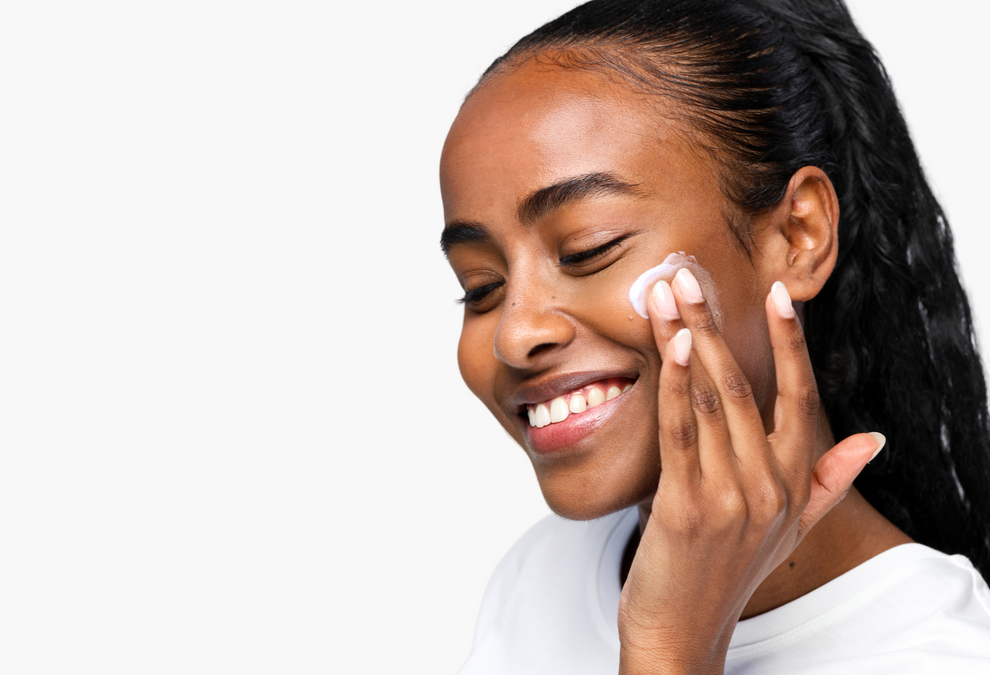
Apply it generously. Most people use far too little, and that’s one of the main reasons sunscreen sometimes doesn’t protect as well as it should.
The ideal amount depends entirely on the size of the area you are covering, and each area has its own requirement (e.g., your face). There is only one practical rule to ensure you apply enough: spread a visible, even, generous layer onto your Skin. Don't forget the often-overlooked areas: neck, ears, temples, hairline, and the backs of your hands. These zones are just as exposed as your face, but they are rarely covered properly.
Sun protection even when it's cloudy?
Yes. Why do you need to wear sunscreen even when it’s cloudy? The answer lies entirely in the UVA.
Clouds block most UVB rays, but on overcast days, up to 90% of ultraviolet rays still manage to reach your Skin, especially UVA rays. UVA rays are the ones responsible for photoaging: wrinkles, loss of elasticity, and the development of dark spots over time. They are the "silent" damage, the kind that do not show up the next day like a sunburn, but instead accumulate over the years.
There is a more reliable parameter than the weather to figure out when protection is needed, and it is theUV Index: it measures the intensity of UV radiation on a scale from 1 to 11+. The higher the value, the more intense the radiation. It varies by date, season, location, current cloud cover, and altitude. The general rule of thumb: if the UV Index is 3 or higher, sun protection is recommended. You can look up this metric in all major weather apps, or by searching "UV Index" along with the name of your city on Google.

Mineral or chemical filters: which should you choose?
There is no right or wrong choice: both offer protection, both are safe, and both are regulated by the same European authorities.
Over the years, marketing surrounding mineral filters has fueled a string of product labels that do not align with the true formulation of these items. Mineral filters are not 'natural' nor 'chemical-free': zinc oxide and titanium dioxide, the only two approved under the European Cosmetics Regulation, are largely produced via industrial synthesis and chemically coated to integrate properly into cosmetic formulas.
Mineral (or “physical”) sun filters are often described as a barrier that reflects UV rays, but they actually work the same way as chemical filters: most of their protective action comes from absorption, not reflection.
The main practical differences relate to their cosmetic finish. Mineral filters tend to leave a white cast on your Skin that rarely fades completely, and they do not layer well under makeup. Latest-generation chemical filters are photostable, have lighter textures, and integrate seamlessly into your daily Skin care routine.
Our Face Fluids SPF 30 and SPF 50 They are formulated with broad-spectrum, photostable, latest-generation chemical filters, consistent with a product designed for daily use under makeup that absorbs quickly.
At the end of the day, the best sunscreen is the one you actually apply every day.
Sun cream and sun lotion: what’s the difference?
The difference is in the format and texture, not in the effectiveness.
A sun cream or sun fluid has a thicker, more structured consistency; you apply it with your fingers, and it is designed for smaller areas that require precise application: the face, neck, décolletage, and hands. A sun milk, by contrast, has a lighter, more fluid texture, often comes in a spray format, and is made to quickly cover large surfaces like the body, perfect for use on vacation or at the beach.
When using products with the same SPF, applied in the correct amount, they all offer identical levels of protection. Your choice comes down to intended use: a fluid or cream formula is most practical for the face, where sunscreen layers easily under other skincare products and makeup; a spray lotion is more functional for full-body application during active sun exposure.
Skin First’s SPF 30 and SPF 50 face fluids are purpose-built for daily facial use: the 50 ml format is designed to last a long time with just one application per day, and integrates seamlessly into your everyday skincare routine as the final step.
Sunscreen is the skincare product with the absolute highest effect-to-prevention ratio there is. The sun is the leading cause of photoaging, a type of skin damage that no anti-wrinkle cream can ever fully compensate for over time. Even so, it remains the most underrated skincare product. I often hear people tell me, 'I only wear it if I’m going to the beach.' But applying it every single morning creates a difference that will be clearly visible 10 years from now.
— Dr. Maria Pia Priore, pharmacist, cosmetologist, and founder of Skin First®

In conclusion
Sunscreen has been discussed for decades, yet it remains the product surrounded by the most doubts and half-truths. Most of these confusion is resolved by shifting your perspective: sunscreen is not just 'that thing you put on at the beach'. It is the first step in your morning Skin care routine, every day, in every season. Questions like how to choose the right sunscreen, how much to use, and when to apply it all become clear naturally once sunscreen is a regular part of your morning habits.
The sun does not wait for your Skin to be ready. It is our job to be prepared first.


- Choosing a selection results in a full page refresh.
- Opens in a new window.