


The correct order of a skincare routine
The benefits of a consistent skincare routine
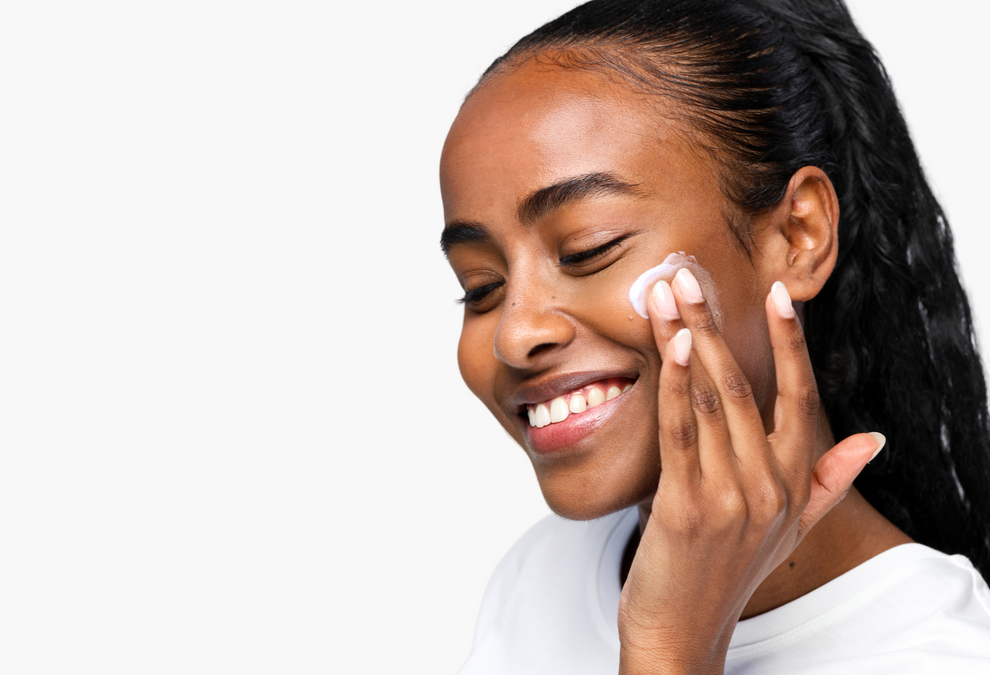
A consistent, regularly followed skincare routine makes a difference over time. It won’t work in three days, but it absolutely will over a few months: your skin barrier stays more balanced, the appearance of dark spots and First wrinkles improves, Skin becomes easier to manage when the season changes. What matters, almost always, is not the product itself. It is consistency.
The steps of a skincare routine
A complete skincare routine consists of six steps in the morning and seven in the evening. Below you will find the full skincare step sequence, with recommended products and guidance for each step.

The golden rule: from lightest to densest
The correct order for applying skincare follows one simple rule: you layer products from the lightest texture to the thickest. Start with the most watery formulas (cleansers, toners, serums or boosters) and work your way up to the heaviest, most substantial products (moisturizers, oils, SPF). For example: a thick moisturizer applied before a lightweight serum creates a barrier that prevents the active ingredients from reaching the Skin.
☀️ Morning skincare routine
Your morning skincare routine preps your Skin for the day ahead. Let’s break down the steps of your facial skincare routine, one by one.
1. Cleanser
This sounds obvious, but it’s the most common mistake people make. Some people skip cleansing in the morning, thinking that "their Skin is already clean anyway". That’s not true: even while you sleep, your Skin produces sebum, comes into contact with your pillow, and collects environmental particles.
The Gentle Face Cleanser is the most universal all-purpose choice. For anyone with Impure skin, oily or combination skin, the Purifying Cleansing Mousse is formulated with 2% Salicylic Acid and Polylysine.
2. Toner
Toner is a liquid solution applied after cleansing. Depending on its formulation, it hydrates, soothes, and refreshes. It is not an essential step.
You’ll often read that toner’s purpose is to "rebalance your Skin’s pH". That’s not the case: your Skin naturally rebalances its own pH, and well-formulated facial cleansers already respect the Skin’s pH. In modern skincare, toner is useful for the specialized benefits it delivers, not as a pH corrector.
3. Serum/Booster
The booster is a concentrated product with a fluid texture, formulated with specific active ingredients to address one precise need: hydration, brightness, dark spots, First wrinkles. Apply three or four drops by patting them onto the face.
In the morning, the most typical choice is the Vitamin C Booster, whose antioxidant action pairs well with sunscreen. For those seeking hydration, the Hyaluronic Acid + Ceramides Booster, suitable for all skin types. For Impure skin or to even out your complexion, the Niacinamide + Azeloglycine Booster.
4. Eye Contour Gel
The periorbital area is thinner, more sensitive, and lacks sebaceous glands, so it is cared for with a dedicated product. Apply it by patting with the pad of your ring finger around the orbital bone.
Our Eye Contour Gel addresses the most common concerns of this area: hydration, the appearance of dark circles, and the first signs of fatigue.
5. Face Cream
Facial moisturizer should be chosen based on your Skin type. A moisturizer made for dry Skin applied to oily Skin will weigh it down. A moisturizer for blemish-prone Skin applied to sensitive Skin will cause irritation.
Three representative picks from our catalog: the Cica Barrier Face Cream for sensitive skin or skin with a compromised skin barrier, the Purifying Face Cream for blemish-prone, oily or combination skin, the Nourishing Face Cream for dry skin or those looking for more intense comfort. If you aren't sure which to choose, the Skin Type Quiz will guide you in just a few minutes.
6. Sunscreen
SPF is the final morning step, right after moisturizer. It is the skincare product with the highest effect-to-prevention ratio of all: exposure to UV rays is the primary cause of photoaging, dark spots, loss of tone, and loss of firmness.
It matters year-round, not just in summer. UVA rays pass through clouds and glass: in the city, in the car, at your desk in front of a window. The practical rule: when the UV Index is 3 or higher, sunscreen is recommended.
Our SPF 30 Face Fluid and SPF 50 are designed for this: lightweight, fluid texture that layers easily over moisturizer and under makeup. If you want to learn more, we covered this in "Sunscreen: 11 Questions We All Have".

🌙 Evening skincare routine
At night, your Skin sheds all the buildup that accumulated throughout the day and has extra time to absorb treatment products. Your evening skincare routine is more in-depth than your morning one, because the steps of your nightly routine also include makeup removal and exfoliation.
1. Makeup Remover
If you wore makeup or SPF during the day, you need to double cleanse in the evening. The first step is an oil-based makeup remover that lifts away makeup, sunscreen, and environmental pollutants. Skipping this step leaves a film on your Skin that clogs pores and prevents all subsequent skincare products from working effectively.
The Oil to Milk Cleansing Makeup Remover it is applied to dry Skin, massaged in to break down impurities, then emulsifies on contact with water before being rinsed off.
2. Cleanser
Use the same cleanser as in the morning, but this is the second step of double cleansing: it completes the cleanse by removing water-soluble residues that the makeup remover oil did not pick up.
3. Exfoliant
Exfoliation is an evening-only step, not a daily one. It removes dead cells that build up on the surface of your Skin, which over time leave your complexion dull and clog your pores.
There are two families of exfoliants: mechanical (scrubs, granules) and chemical (acids). Chemical exfoliants are generally more precise, because they break down the bonds between dead skin cells instead of removing them through friction. The Skin Perfecting Toner is a chemical exfoliant formulated with 2% Salicylic Acid, suitable for most skin types. The Purifying Toner is formulated for Impure skin or skin with active blemishes.
Use frequency depends on the product: always read the label.
4. Toner
The same rule applies here as it does for your morning routine: this step is useful, but not mandatory. A quick note: exfoliating toners formulated with AHA or BHA are not "standard" toners—they are full-fledged chemical exfoliants, and they are used in the step before this one. If you use the Skin Perfecting Toner or the Purifying Toner, you skip this step.
5. Serum/Booster
In the evening, the go-to booster is the Retinol Booster, the gold standard anti-aging booster, which should only be used in the evening because it can make your Skin more sensitive to UV rays. For blemishes or post-inflammatory dark spots, theNiacinamide + Azeloglycine Booster. For hydration, the Hyaluronic Acid + Ceramides Booster.
💡 Skin First Tip: you can use a maximum of two boosters per day: one in the morning and one in the evening. Any more than that risks overwhelming your Skin without improving results.
6. Eye Contour Gel
Same product, same application motion as in the morning.
7. Face Cream
Use the same moisturizer as in the morning. It is often said that you need two different moisturizers, one for day and one for night: this is not necessary, it's a marketing simplification. The only thing that changes is the presence of SPF in the morning and photosensitizing ingredients like retinoids or acids in the evening.
What to add occasionally
In addition to your daily steps, there are treatments you can add on a regular basis. They aren't essential to start, but they make a big difference over time.
- Face Mask: once or twice a week, after cleansing. The Hydrating Face Mask combines Hyaluronic Acid, Niacinamide and Ceramides. The Purifying Face Mask, featuring balanced clay blended with Hyaluronic Acid, is formulated for Impure skin.
- Spot Treatments: apply only to the affected area. Purifying gel treatments should be applied directly to blemishes, both before and after moisturizer. Brightening gels, before moisturizer, one to two times per day.
- Face Oil: this is an optional treatment, applied on top of your cream to lock in hydration. It is not suitable for those with Impure skin or a tendency to develop pimples. For dry or mature skin, it is a great addition to your evening skincare routine.
The right routine for every Skin type
Skincare starts with your Skin type. We’ve built a customized routine for every type, with products formulated to work in synergy:
- Oily & Blemish-Prone Skin Routine
- Dry skin protocol
- Combination skin protocol
- Congested skin protocol
- Sensitive (or Prone to Redness) Skin Routine
- Normal skin protocol
If you don’t know what your Skin type is, take theSkin Type Quiz: we'll help you choose in just a few minutes.
If reading through these steps feels like they are far too many, I understand. You can start with a basic skincare routine and build it up over time. For the morning, all you need is a cleanser, a facial cream suited to your Skin type, and SPF. For the evening, use a makeup remover, cleanser, and facial cream, plus an exfoliant once or twice a week. Extra steps are added based on what your Skin needs: a booster for a specific concern, the Eye Contour Gel when you need a dedicated treatment for that area, and a toner if you are looking for an extra targeted action. Skincare is built by listening to your Skin, not by accumulating products.
— Dr. Maria Pia Priore, pharmacist, cosmetologist and founder of Skin First®

In conclusion
Skincare order is not a technical detail reserved for professionals. It is what allows your products to work at their best, and once it becomes part of your morning and evening routines, it becomes automatic.
Skincare is not a to-do list. It is a way to take care of yourself.


- Choosing a selection results in a full page refresh.
- Opens in a new window.